
Investing Foundations: Learn the Rules of Money
$34.99
BASE LEVEL / BEGINNER INVESTING
Learn the rules of money.
Build your investing confidence.
Go from complete beginner to understanding the foundations of investing. Discover how stocks, bonds, ETFs, compound growth and diversification work, and learn to build a practical long-term investment plan.
WHAT YOU’LL MASTER
✓ Stocks, bonds, ETFs and index funds
✓ Risk, returns, inflation and compound growth
✓ Avoiding common beginner mistakes
✓ Building your first investing roadmap
COURSE DETAILS
12 Lessons across 4 Modules
Duration: 2 Hours 30 Minutes
Level: Beginner
Final Quiz: 80% Passing Grade
BASE MEMBERSHIP COURSE
Included with your CryptoHolder Base membership.
Description
CRYPTOHOLDER ACADEMY / BASE LEVEL / INVESTING
INVESTING FOUNDATIONS
Learn the Rules of Money
Understand the markets. Master the fundamentals. Build the knowledge to take control of your financial future.
COURSE AT A GLANCE
Level: Beginner / Base
Lessons: 12
Modules: 4
Estimated Duration: 2 Hours 30 Minutes
Final Assessment: 10 Questions / 80% Passing Grade
MONEY DOESN’T COME WITH A MANUAL. UNTIL NOW.
Everyone talks about building wealth, but few people explain how investing actually works.
What is a stock? How do bonds work? Why do investors use ETFs? What makes investments grow or lose value? And how can you start investing without blindly following the crowd?
Investing Foundations: Learn the Rules of Money is designed to answer these questions from the ground up. You’ll explore the building blocks of investing, learn how different assets behave, and discover the principles behind a disciplined long-term investment strategy.
No complicated jargon. No get-rich-quick promises. Just practical financial education designed to help you make more informed decisions.
WHAT YOU’LL LEARN
✓ Understand what investing is and how it differs from saving.
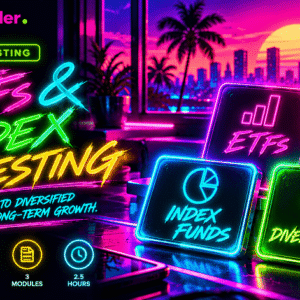
✓ Explore stocks, bonds, cash, ETFs and index funds.
✓ Learn how investment returns and losses happen.
✓ Understand inflation and its impact on purchasing power.
✓ Discover compound growth and the importance of consistency.
✓ Learn why diversification matters when managing risk.
✓ Understand risk tolerance, risk capacity and time horizons.
✓ Recognise common mistakes made by beginner investors.
✓ Build a practical roadmap for your investing journey.
INSIDE THE COURSE
MODULE 01 / 3 LESSONS
Understanding Investing
Discover what investing really means, why people invest, and how to approach the financial markets with a beginner-friendly understanding of risk and reward.
MODULE 02 / 3 LESSONS
Understanding Investment Assets
Explore stocks, bonds, cash and other investment assets. Learn how ETFs and funds work, and why spreading investments across different assets can help manage concentration risk.
MODULE 03 / 3 LESSONS
How Investing Really Works
Understand how investments make and lose money, why inflation matters, and how time, compounding and consistent contributions can influence long-term investment outcomes.
MODULE 04 / 3 LESSONS
Becoming a Smarter Beginner Investor
Learn to set investment goals, identify common beginner mistakes, assess your financial situation, and create a practical roadmap for your first investing journey.
BUILT FOR COMPLETE BEGINNERS
You don’t need a finance degree, trading experience, an investment account or any money invested to begin.
This course starts with the fundamentals and builds your understanding one lesson at a time.
TEST YOUR KNOWLEDGE
Complete the course with a 10-question final assessment covering the core concepts from all four modules. A score of 80% or higher is required to pass.
BUILD YOUR FOUNDATION. OWN YOUR FUTURE.
Investing isn’t about predicting every market move. It’s about understanding your choices, managing risk, developing good habits and making informed decisions.
Included with your CryptoHolder Base membership.
Disclaimer: This course is for educational purposes only and does not constitute personalised financial or investment advice. All investments involve risk, including the possible loss of capital. Past performance does not guarantee future results.